01 / MODELS
Open-Weight LLMs
Evaluating model capability, reasoning behavior, quantization, context utilization and inference performance on locally controlled infrastructure.
Exploring the architecture, behavior and practical limits of locally operated artificial intelligence systems.
Cygnus X-1 is an independent experimental environment for open-weight language models, local inference, agent orchestration, retrieval, persistent memory, quantitative AI and distributed compute.
Modern AI capability emerges from the interaction between models, context, tools, retrieval, orchestration, memory, compute and evaluation. Cygnus X-1 explores those components directly.
Evaluating model capability, reasoning behavior, quantization, context utilization and inference performance on locally controlled infrastructure.
Exploring routing, tool selection, multi-step workflows, conditional execution and multi-agent coordination using LangGraph.
Combining model reasoning with live web search, private documents and structured data to reduce dependence on static model knowledge.
Investigating the distinction between model weights, context windows, KV cache and external long-term memory systems.
Integrating DuckDB market history and deterministic computation with language-model interpretation and agent routing.
Studying heterogeneous AI compute, model placement, inference routing and future multi-node DGX Spark experimentation.
The current environment separates public access, orchestration, inference and data services while keeping the primary model computation under local control.
The system separates public access, application services, agent orchestration, inference and external data sources into discrete operational layers.
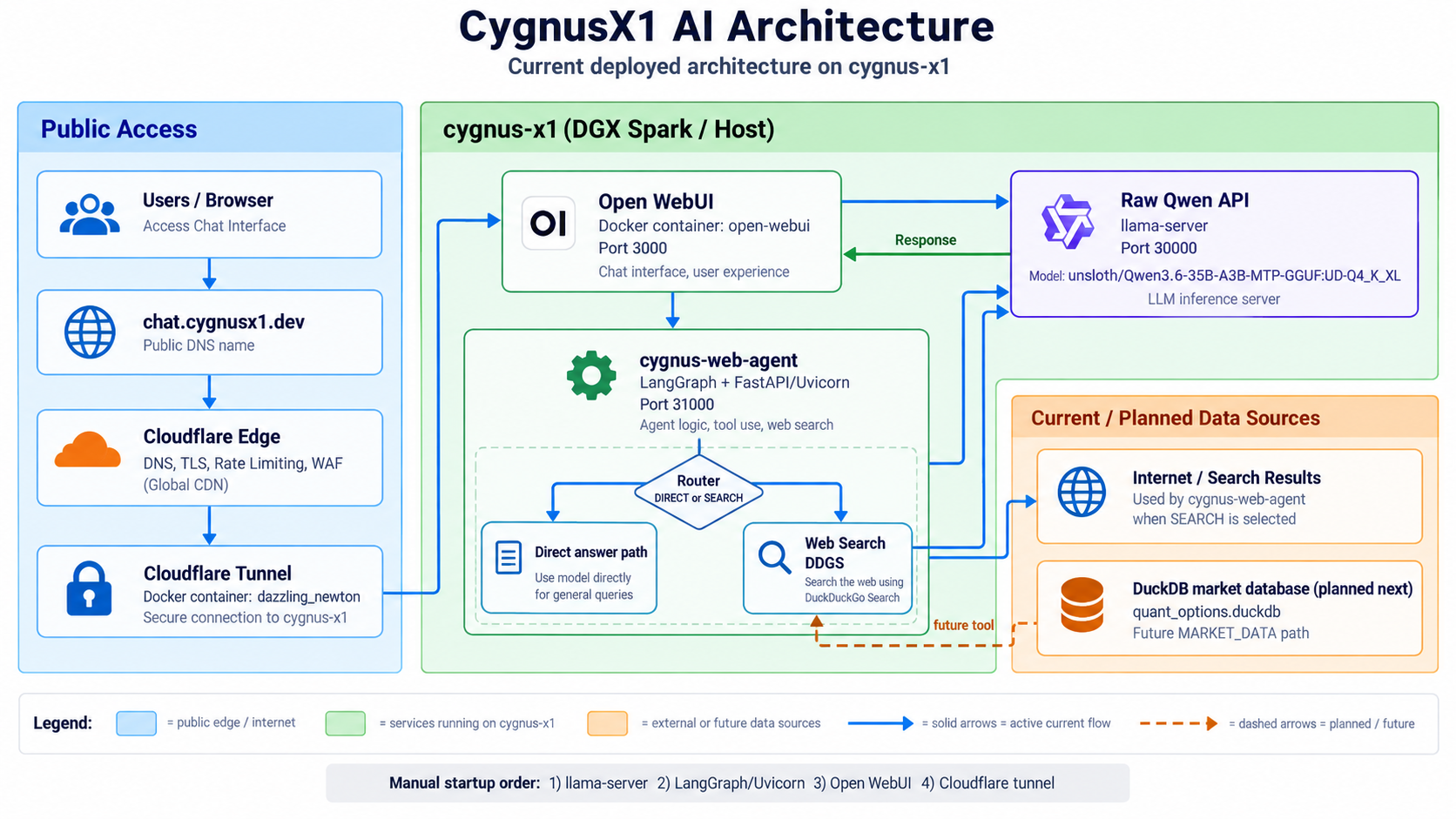
Experiments focus on understanding what actually improves AI-system capability rather than relying only on published benchmark scores.
The agent determines whether a request can be answered from model knowledge or requires current external information.
Comparing Qwen responses with reasoning enabled and disabled to determine where additional reasoning tokens materially improve accuracy.
Route quantitative questions to historical OHLCV data in DuckDB, perform deterministic calculations and return results to Qwen for interpretation.
Study collaboration, specialization, communication, error propagation and collective problem solving among multiple logical agents sharing the same inference infrastructure.
Keep primary inference and experimental control on infrastructure that can be directly observed, configured and measured.
Prefer deterministic tools, current sources and structured data when factual precision matters.
Evaluate accuracy, latency, token use, routing decisions and failure modes before claiming a system improvement.
The Cygnus AI Lab exposes the current experimental stack: local Qwen inference, LangGraph orchestration and adaptive web-search routing.
Launch Cygnus AI Lab ↗